
Lily Aaron
Federal Policy Fellow
In September 2023, a slow-moving storm dumped up to nine inches of rain on Calumet City. Basements flooded, cars sat submerged, and families were left gutting their homes by hand. As one resident who lost her belongings put it, everything was “just floating around”. Mayor Thaddeus Jones called it a storm no municipality could have prepared for. According to reporting from ABC7 and CBS, damage estimates for some residents ran into the tens of thousands of dollars, much of it not covered by insurance.
This past July, the region came close to a repeat, on a bigger scale. After a weekend of severe storms, Cook County’s stormwater reservoirs held over 13 billion gallons of water, roughly 20,000 Olympic-sized pools. According to the Metropolitan Water Reclamation District (MWRD), the McCook Reservoir reached full capacity on July 3, the sixth time this year, compared to just five times total between 2021 and 2025. Just north of Calumet City, WTTW reported that the Thornton Reservoir reached 94 percent capacity, the fullest it’s been since opening in 2015, well above its previous high mark of 54.5 percent set in 2019.
Neither reservoir overflowed. But MWRD engineers warned that if either one had, sewage and stormwater could have backed up into the same streets and basements Calumet City residents are still trying to rebuild.
So, what is the deep tunnel?
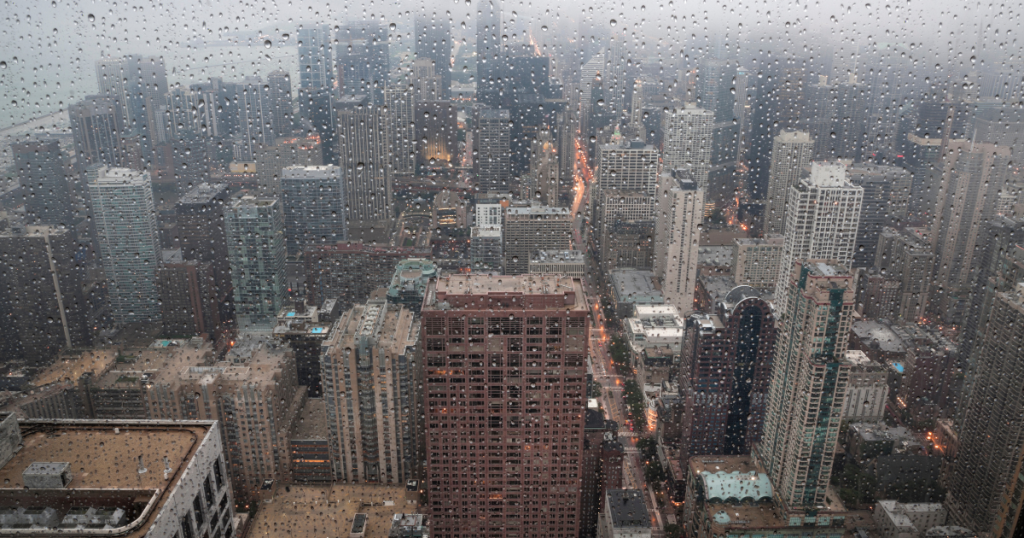
Here’s the basic chain of events during a big storm: rain falls faster than Chicago’s aging sewer system can handle, especially in neighborhoods with combined sewers that carry both stormwater and sewage in the same pipes. Without somewhere for that excess water to go, it backs up into streets and basements or overflows into local rivers.
That’s what the Deep Tunnel, officially the Tunnel and Reservoir Plan, was built to prevent. Over 100 miles of tunnels, buried up to 300 feet underground, capture that excess water and carry it to massive underground reservoirs like McCook and Thornton. The reservoirs hold the water until treatment plants can process it and safely release it back into local waterways.
The process is straightforward: rain falls, the tunnels catch what the sewers can’t, the reservoirs store it, and the water gets treated before release. It’s one of the largest public works projects in the country, and it’s the reason Chicago doesn’t see the sewage-in-the-street flooding it once did.
However, as we’ve written before, even a system of this size has limits, especially as storms grow more intense and the sewer pipes feeding into it remain built for an earlier climate.
Where WRDA comes in
It’s easy to think of federal water policy as something that happens in Washington and stays there. The Deep Tunnel is proof that it doesn’t.
The McCook and Thornton Reservoirs exist because of a partnership between MWRD and the Army Corps of Engineers, funded through the Water Resources Development Act, or WRDA. Congress passes WRDA roughly every two years to authorize funding for flood control and water infrastructure projects nationwide. Since reauthorization isn’t automatic, every cycle is a decision about whether projects like these keep getting built, maintained, and expanded.
Rep. Mike Quigley, who represents Illinois’ 5th Congressional District (IL-05), has pushed for this kind of investment for over a decade, including helping secure federal funding for these same reservoirs earlier in his time in Congress. McCook itself is still being expanded through a project to nearly triple its capacity by 2032, funding that depends on this same law.
In other words, WRDA isn’t an abstraction. It’s the tunnel under your street.
P.S. Want to go deeper on WRDA? We recently broke down what this law means for Illinois communities in a short webinar. Watch it here.
Who is most at risk?
Not every community is equally exposed. Southeast Cook County and the south suburbs, much of which falls in Illinois’ 2nd Congressional District (IL-02), face some of the region’s highest flood risk. This stems from a combination of aging infrastructure, low-lying terrain, and heavy reliance on the same combined sewer systems the Deep Tunnel was built to relieve. Calumet City sits in the middle of that risk zone, which is part of why 2023’s flood hit as hard as it did.
That pattern holds across the city, too. Flooding in Chicago disproportionately hits Black and Brown neighborhoods, a pattern tied less to bad luck with the weather and more to decades of underinvestment in the infrastructure meant to protect those communities in the first place. When federal investment slows or stalls, it’s these same neighborhoods that absorb the impact first.
Federal investment matters
The storms behind this July’s near-miss weren’t a fluke. Heavy rainfall events in the Great Lakes region have grown more frequent and more intense in recent decades as the climate has gone into crisis, and infrastructure built decades ago is increasingly being asked to handle conditions it wasn’t designed for. That’s not a reason to write off the Deep Tunnel. It’s a reason to keep investing in it.
WRDA may sound like federal policy jargon, but it’s the reason a reservoir near South Holland can hold back billions of gallons of water instead of sending it into someone’s basement. Whether that continues, and whether communities like Calumet City are protected the next time a storm like 2023’s hits, depends on Congress choosing to keep this investment flowing.
About the Author
Lily Aaron is IEC’s Federal Policy Fellow, working on clean water and Great Lakes advocacy in Illinois’ 2nd and 5th Congressional Districts. Her background in environmental science research, from stream health assessments to habitat restoration fieldwork, shapes how she connects federal water policy to what it actually means for Illinois communities. She is passionate about translating complex infrastructure and policy issues into stories people can see themselves in (and mycology too!).