Keegan Sullivan
Energy Campaigns Associate
Even to an outsider, it’s clear that the skyline in Vancouver, British Columbia, is changing. Walking through the city’s downtown and harborside neighborhoods, it’s impossible not to notice row upon row of newly built apartment towers. You can’t help but see crews of workers heading to job sites and the 370 cranes those crews operate across British Columbia. Vancouver is simultaneously trying to meet extraordinary housing demand in one of North America’s most expensive markets while meeting its ambitious climate goals and commitment to sustainability. Like many cities, they are trying to build fast while achieving a 45% reduction in emissions across the metro region. With its own ambitious climate goals and current reliance on fossil fuels to heat and power our buildings, Illinois can look to Vancouver for creative and sustainable solutions.
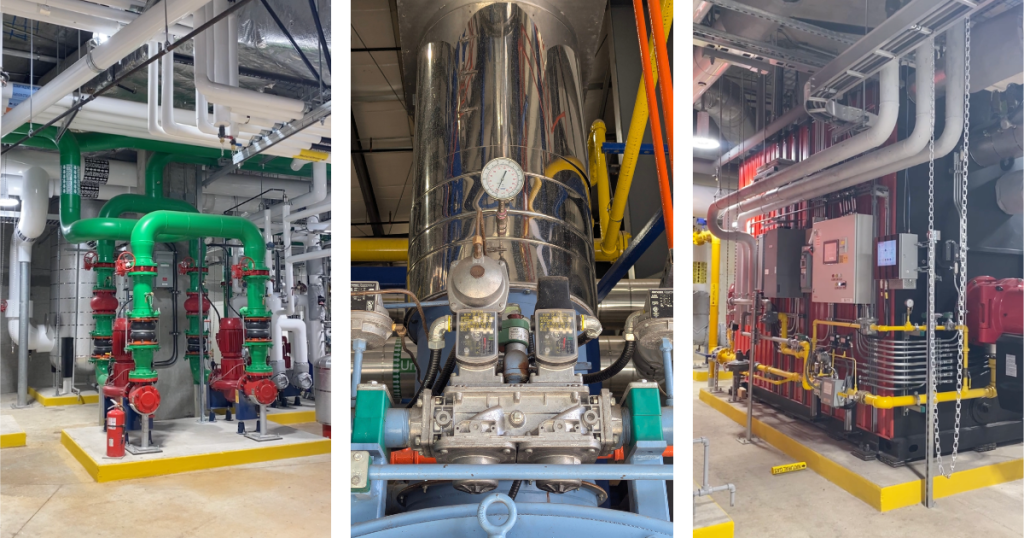
Underneath the cranes and the glittering new apartment towers, something especially interesting is happening with how Vancouver heats and cools its buildings. Vancouver is embracing a growing system of thermal energy networks (TENs) to decarbonize both new and existing buildings. Some of the city’s most exciting developments are heated and cooled entirely by low-carbon sources of energy. Many of Vancouver’s new rental units will be powered by waste heat from the sewers or geothermal wells underneath their structures. IEC convened a group of Illinois’ environmental legislative champions and organized labor leaders to visit Vancouver and tour these facilities.
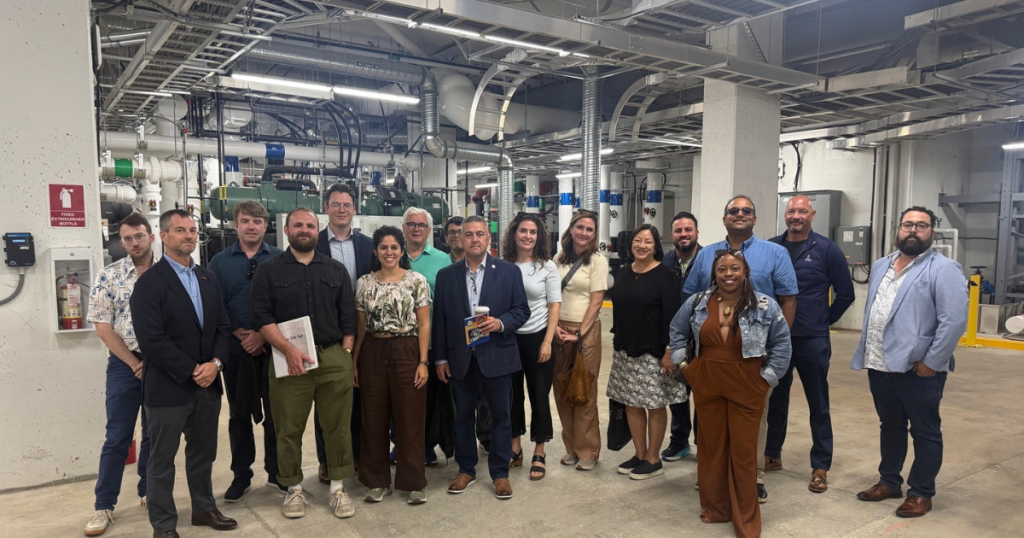
State Senator Ram Villivalam, State Senator Omar Aquino, State Senator Patrick Hanley, and State Representative Theresa Mah and our partners in organized labor including III FFC, LiUNA, Climate Jobs Illinois, Gasworkers Union Local 18007, International Union of Operating Engineers Local 150, and the Chicago Federation of Labor traveled all the way to Canada with us to learn about this ingenious way of heating and cooling buildings.
At their most basic, thermal energy networks are a network of pipes that transfer heat carried by water or air between buildings. They allow buildings to share heat between each other and various sources, from geothermal wells, industrial facilities, and surface or underground water. TENs pull heat from these low-carbon sources to heat or cool every connected building, providing them with pollution-free comfort. TENs are often built with incredibly efficient electric heat pumps, giving them the flexibility to heat or cool with minimal electricity. Heat in the winter, cool in the summer, all with minimal carbon emissions. While TENs are best suited for densely populated city blocks like Vancouver or Chicago, this remarkably flexible energy technology can also be purpose-built to serve a single apartment building, a school or university campus, or an entire neighborhood.

In Vancouver, IEC staff and our cohort saw a wide range of TENs with different heat sources, decarbonization paths, ownership models, and service areas. Housing developments like Vancouver’s Sen̓áḵw project showcase the potential for carbon-free heating and cooling in new construction. Following decades of land dispossession, the Squamish Nation worked for generations to see parts of their ancestral land returned. In 2003, 10.48 acres of their original 80 acres were rightfully returned, and on that very land, they are now building one of the most impressive low-carbon housing complexes in the world. Eleven buildings with more than 6,000 rental units will be heated and cooled entirely by a sewer-heat recovery district energy system. Heat will move from unit to unit through high-efficiency heat pumps and supplemented with electric boilers. The project’s energy team expects to avoid 4,000 tons of greenhouse gas emissions compared to conventional gas boiler heating systems.
Between the ultra-efficiency of these systems and the opportunities for low-carbon neighborhood energy, energy experts and environmental advocates are understandably giddy about the prospects for TENs. Labor is, too. Thermal energy networks and geothermal energy are an incredible bridge technology for transitioning current laborers. Because TENs are an underground piped system, they require the expertise of skilled workers already employed in the utility trades. It’s hard to overstate the work opportunities these systems provide for pipefitters, operating engineers, laborers, utility workers, and more. The Utility Workers Union of America (UWUA) notes that these technologies have the potential to scale nationwide and provide job opportunities to utility workers. Worker experience on early pilot projects has already given UWUA workers insights into increasing their efficiency and cost-effectiveness. Ultimately, the union agrees that thermal energy networks are a significant path forward in the just energy transition.
See TENs in action: Check out our quick video recap from the Vancouver tour below!
Illinois is still learning how to embrace TENs, but interest from the state’s labor unions and their members is strong. With our organized workforce, urgent housing needs, and environmental policy leadership in the General Assembly, there is no reason we cannot lead the country in TENs adoption. The Clean and Reliable Grid Affordability Act, passed in 2025 with the help of environmentalists and unions alike, provides $10 million for TENs pilot projects and the trades are ready to go to work. The International Union of Operating Engineers (IUOE) Local 150 already has a training site for geothermal and water well drillers, a skill crucially needed for TENs using geothermal wells.
TENs also open up opportunities for community energy ownership that can profoundly improve local resilience, lower peak electricity demand, and bring down energy bills in the long term. If Illinois is to meet its climate goals and provide meaningful career pathways for workers, we need to get building.
About the Author
Keegan Sullivan is IEC’s Energy Campaigns Associate, supporting the Energy and Communications teams. Keegan works with IEC’s legislative, programs, and communications experts to deliver thoughtful campaigns advancing dignified solutions to decarbonize the built environment. Keegan firmly believes a just and equitable energy transition will be a powerful force for social change.
Read more by Keegan: